How is PRP prepared and classified?
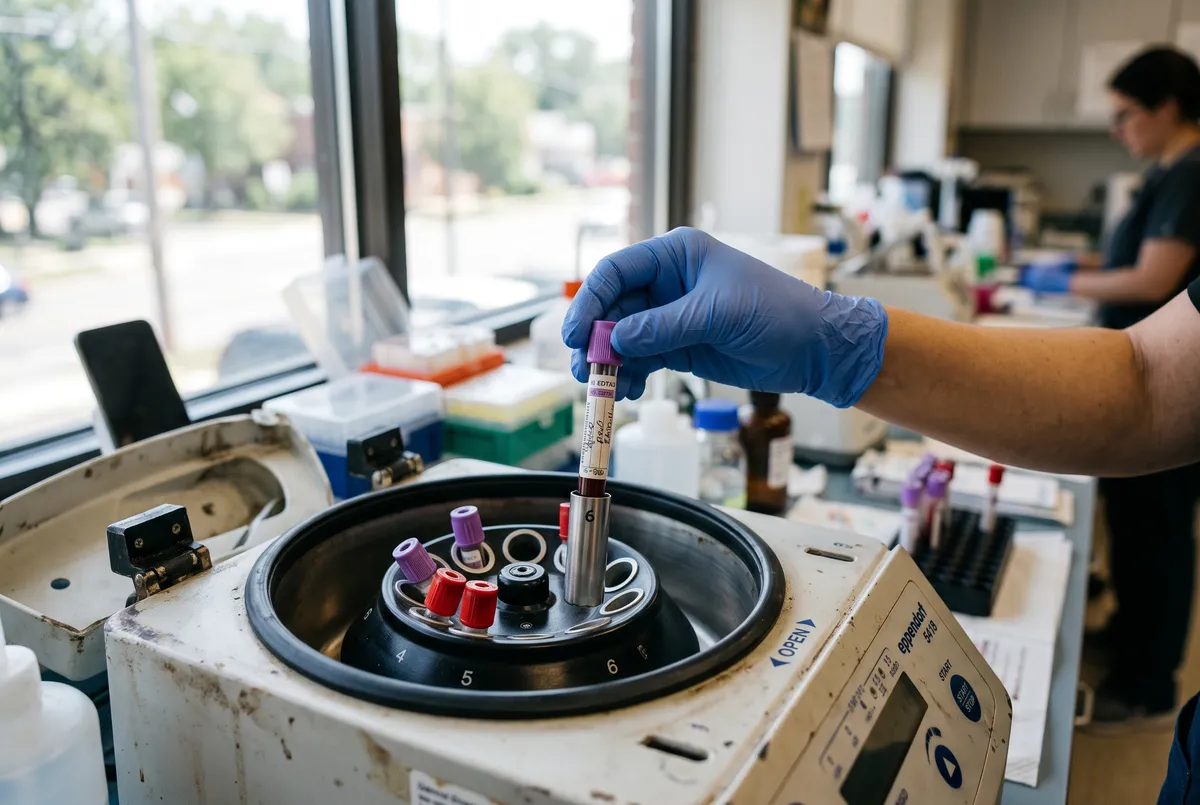
PRP is made by drawing blood and separating it by centrifugation. Preparation varies widely, which is why classification systems and quality control matter.
Key takeaways.
- Every step from blood draw to final product influences what the PRP contains.
- Centrifugation separates blood into red cells, a buffy coat and plasma.
- Protocols use either a single or a double centrifugation.
- Classification systems describe PRP by leukocytes, fibrin, platelet count and activation.
- Lack of standardization makes PRP studies hard to compare.
- Platelet concentration assessment is the most basic quality control measure.
From blood draw to product
PRP preparation starts with the blood draw. The course material stresses that collection is often underappreciated, yet it affects final product quality. Patient factors such as hydration and recent medication can affect platelet function.
Collection technique also matters because platelets can be damaged or activated too early during handling.
What centrifugation does
Centrifugation separates blood by density. A first spin produces three layers: red blood cells at the bottom, a thin middle layer called the buffy coat, and plasma on top. The buffy coat holds most of the white blood cells and platelets.
Protocols use either one spin or two. Each approach has its own advantages, and the choice changes what ends up in the final product.
How PRP is classified
Because preparations differ so much, several classification systems exist. The most widely recognized, from Dohan Ehrenfest and colleagues, sorts products by two variables: whether white blood cells are present, and the fibrin architecture.
Later systems add more detail. The PAW system, introduced in 2012, describes platelet count, activation method and white blood cells. The Mishra system uses similar variables. The DEPA system, proposed in 2016, adds concepts such as the total platelet dose and how efficiently platelets are recovered from whole blood.
Quality control and the standardization problem
The PRP literature reports methods and composition inconsistently. This makes it hard to compare trials that used different protocols, and it may explain some of the variation in reported outcomes.
Platelet concentration assessment is the most basic quality control measure. Periodic testing helps a practice confirm that its protocol produces a consistent product. Describing a preparation with a classification system makes results easier to interpret.
Educational content for healthcare professionals. Not a treatment recommendation. PRP applications are considered off-label.
This guide covers the what and the why.
The how is taught live. The webinar and live training go deeper on:
- Step-by-step collection and processing
- Centrifugation settings and protocol choice
- Preparation system and kit selection
- Practical quality control in a clinic
- Documenting a preparation with a classification system
Common questions.
What is the buffy coat in PRP preparation?
What PRP classification systems exist?
Why do PRP studies report such different results?
Sources
- Fadadu PP, et al. "Review of concentration yields in commercially available platelet-rich plasma (PRP) systems: a call for PRP standardization." Reg Anesth Pain Med. 2019;44(9):652-659.
- Dhurat R, Sukesh M. "Principles and Methods of Preparation of Platelet-Rich Plasma: A Review and Author's Perspective." J Cutan Aesthet Surg. 2014;7(4):189-197. PMC4338460.
- National IADVL PRP Taskforce. "Preparation of Platelet-Rich Plasma." Indian J Dermatol Venereol Leprol. 2021;87(6):747-756. PMC8664176.
Keep reading.
PRP · 3 min read
How is PRP thought to work? Proposed mechanisms of action
Research describes four linked mechanisms for PRP: tissue repair signaling, new vessel formation, immune modulation and anti-inflammatory effects.
Start the lessonPRP · 3 min read
Types of PRP: leukocyte-rich vs leukocyte-poor and other variations
PRP is a family of preparations, not one product. They differ in white cell content, platelet concentration, source, activation and physical form.
Start the lessonPRP · 3 min read
Is PRP safe, and how does the FDA regulate it?
Systematic reviews report mostly minor, short-lived side effects with autologous PRP. PRP is regulated as a blood product and its applications are considered off-label.
Start the lessonReady for the hands-on detail?
Live on Zoom, Tuesdays at 12:00 PM ET. See how the model works before you commit to anything.