Types of PRP: leukocyte-rich vs leukocyte-poor and other variations
PRP is a family of preparations, not one product. They differ in white cell content, platelet concentration, source, activation and physical form.
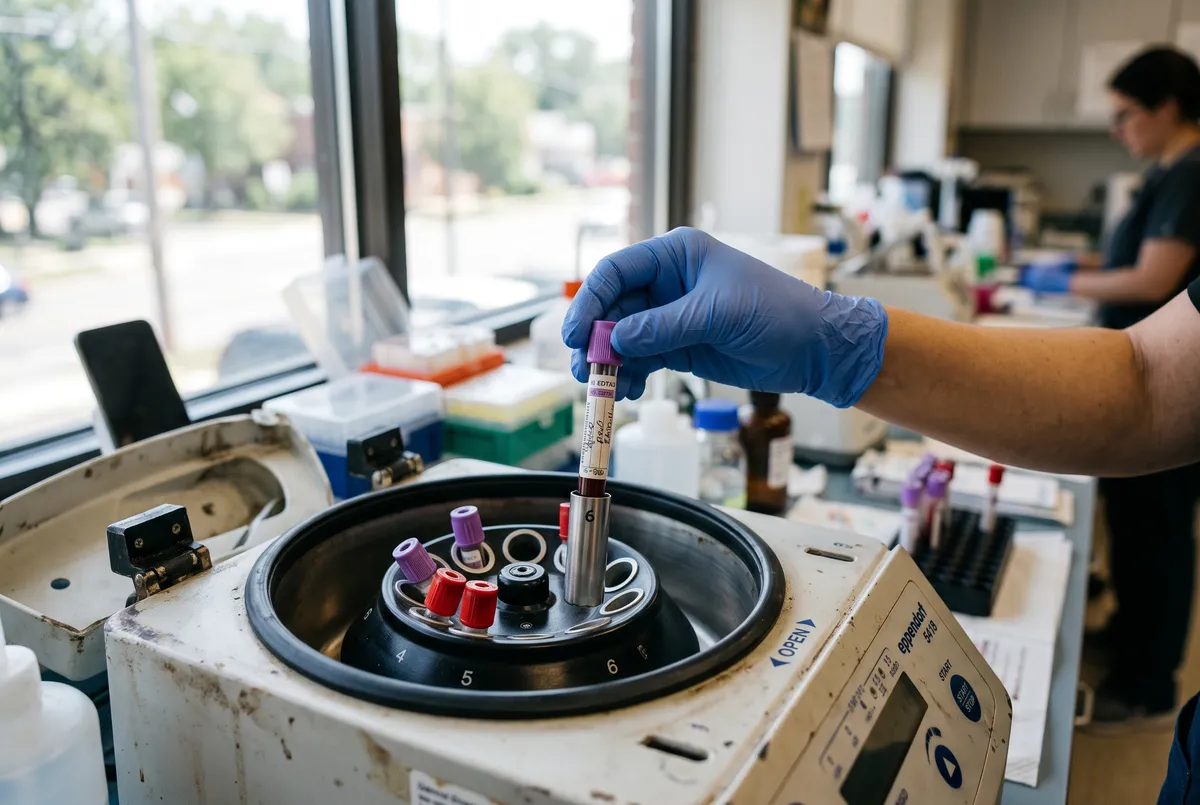
Key takeaways.
- PRP varies in leukocyte content, platelet concentration, activation status and physical form.
- Leukocyte-rich PRP includes white blood cells; leukocyte-poor PRP keeps them to a minimum.
- White blood cells add both antimicrobial factors and pro-inflammatory mediators.
- More platelets does not simply mean better outcomes; the relationship is complex.
- Autologous PRP, from the patient's own blood, is the standard approach.
- PRP can be delivered as a liquid or as a gel with a fibrin scaffold.
Leukocyte-rich and leukocyte-poor PRP
Leukocytes are white blood cells. Leukocyte-rich PRP (L-PRP) is made by collecting the whole buffy coat, so it contains neutrophils, lymphocytes and monocytes along with platelets. Leukocyte-poor PRP (LP-PRP), also called pure PRP, leaves most white cells behind.
The trade-off is real. White cells contribute antimicrobial factors and some growth factors. They also bring pro-inflammatory cytokines and enzymes that break down tissue matrix. The debate over which to use is ongoing, and published trials in the course references reach differing conclusions.
Platelet concentration
It seems intuitive that more platelets would be better. The course material describes the relationship as more complex, with a dose-response pattern and possible biphasic effects. Biphasic means a benefit may level off or reverse beyond a certain point.
Source and activation
Autologous PRP comes from the patient's own blood and is the standard approach. Allogeneic PRP comes from donor blood. It has been explored as an alternative but faces significant practical and regulatory barriers.
Activation status is another variable. Platelets can be activated before injection with an added agent, or left to activate at the treatment site. This choice affects the timing and duration of growth factor release.
Liquid or gel
Liquid PRP is non-activated or minimally activated and stays flowable. It is the form typically used for injection. Gel PRP has a fibrin scaffold, which changes how it is handled and delivered.
These variables interact, so choosing a formulation means weighing the tissue, the patient and the delivery method together. PRP applications are considered off-label.
Educational content for healthcare professionals. Not a treatment recommendation. PRP applications are considered off-label.
This guide covers the what and the why.
The how is taught live. The webinar and live training go deeper on:
- A decision framework for choosing a formulation
- Platelet concentration targets by application
- Activation agents and techniques
- When liquid or gel PRP is used
- Matching leukocyte content to tissue type
Common questions.
What is the difference between leukocyte-rich and leukocyte-poor PRP?
Is a higher platelet count always better in PRP?
Should PRP be activated before injection?
Sources
- Barrachina L, Cequier A, Romero A, et al. Discussing the Debate: Leukocyte-Rich Platelet-Rich Plasma Versus Leukocyte-Poor Platelet-Rich Plasma. Curr Rev Musculoskelet Med. 2024;17(6):243-255. doi:10.1007/s12178-024-09911-0
- Romandini I, Boffa A, Di Martino A, et al. Leukocytes Do Not Influence the Safety and Efficacy of Platelet-Rich Plasma Injections for the Treatment of Knee Osteoarthritis: A Double-Blind Randomized Controlled Trial. Am J Sports Med. 2024;52(12):3120-3130. doi:10.1177/03635465241283500
- Le ADK, Enweza L, DeBaun MR, Dragoo JL. The Effect of Platelet Dose on Outcomes after Platelet Rich Plasma Injections for Musculoskeletal Conditions: A Systematic Review and Meta-Analysis. Curr Rev Musculoskelet Med. 2024;17(5):157-167. doi:10.1007/s12178-024-09922-x
Keep reading.
PRP · 3 min read
Is PRP safe, and how does the FDA regulate it?
Systematic reviews report mostly minor, short-lived side effects with autologous PRP. PRP is regulated as a blood product and its applications are considered off-label.
Start the lessonPRP · 3 min read
How to read PRP research: lab studies, animal models and clinical trials
PRP evidence runs from cell studies to animal models to human trials. Each level answers different questions and has its own limits.
Start the lessonPRP · 3 min read
PRP vs stem cells, exosomes, hyaluronic acid and corticosteroids
How PRP compares with stem cell therapies, exosomes, hyaluronic acid and corticosteroids in mechanism, complexity, evidence and regulatory status.
Start the lessonReady for the hands-on detail?
Live on Zoom, Tuesdays at 12:00 PM ET. See how the model works before you commit to anything.